Friday, January 24, 2014

Latin America in 2014: part II


Chile

For almost forty years, Chile has had the best performing regional economy, one based on a free market model designed by the Chicago Boys[1] and on the development of globally competitive export industries (orchestrated by the Fundación Chile, ironically an offshoot of ITT, the “Great Satan” of the 1970s).

Remarkably, this strategy which had been elaborated by a military regime, has been pursued with only minor alterations by a succession of center-left governments and most recently by center-right President Piñera.  For the first time however, there are some doubts as to whether this continuity will be maitained.

President-elect Bachelet has campaigned on a platform of broad fiscal and social reforms to be funded by higher tax revenues.  Interestingly, her political discourse is significantly to the left of her actual policies when she was in office in 2006-2010.  Some of her other proposals include creating a public pension program and the elimination of the bedrock of foreign direct investment, the Decree Law 600.

Why would President Bachelet change tack?  Is she doing what she wanted to do back in 2006, but politically couldn’t do?  More likely, she is responding to popular pressure and weak global economics, combined with regional populism and reform fatigue at home.

Perhaps the most emblematic proposal is the elimination of the DL 600[2]: in a country where half of the foreign investments are very long term (mining), the DL600 has provided the critical assurances of regulatory and financial stability.  The results have been impressive: US$51 billion in foreign direct investments over the last 10 years in a country with a GDP of $164 billion.  And DL600 was no gift to foreign investors either, as they had to accept paying income tax at a higher rate to avail themselves of the benefits of the DL600.

The proposed termination of the DL600 is all the more surprising since Chile is more reliant on exports (mostly from mining) than its regional peers[3]: these account for 34% of GDP vs. 17% for Argentina and 11% in Brazil.  Despite a sustained diversification effort, copper and other minerals still represent the lion's share of exports.  It is one thing to tell foreign investors that their income will be taxed at a higher rate; it is quite another to imply that the terms under which they made a large investment can now be changed at any time and affect such issues as non-discrimination vis-à-vis local competitors, accounting and profit remittance rules, access to foreign exchange, etc.

In truth, Chile has long had active leftwing political parties and movements, and with populism on the rise in the region, they too have upped the ante.  This has been apparent with demonstrations for free education for all, with blocking electric power projects which had received the approval of government environmental authorities, with blocking mining projects in coordination with local communities, NGOs and some governmental units (in truth, some of these projects were not in full compliance) and recently with a union strike shutting down the main ports of the country and stopping copper and fruit exports[4].

As the speed of regional events seems to be overtaking this blog, it may well be that, once again, Chile will be out of phase with its big neighbors, Argentina and Brazil: successful when these were floundering and declining when these start to shape up.  For even if market forces extract a price for her policies, President Bachelet will be forced to deliver on some of her electoral promises.
 
In conclusion, it is likely that President Bachelet will be forced to water down some of her new policies, simply because they are unaffordable and because the opposition is nor without recourse.  At the same time, Chile is like an ageing Olympic swimmer who, after 15 years of twice-a-day hard practices, finds it increasingly harder to go on, particularly when his friends and neighbors stay in bed until 9 a.m. and play video games.  Foreign investors will take notice, and so will local ones.


[1]  The term refers to a group of young Chilean economists who studied at the University of Chicago and later returned home to formulate and execute free market policies.  Among them were Sergio de Castro (minister of finance 1977-1982), Jose Piñera (minister of labor 1978-1980 and author of the groundbreaking private pension reform), Sergio de la Cuadra (minister of finance 1982-1983), Miguel Kast (minister of planning 1978-1980), and Hernan Büchi, (minister of finance 1985-1989).
[2]  For greater details on the DL 600, please refer to my post of June 28, 2013.
[3]  Countries with GDP per capita of at least US$10,000.  2012 data.
[4]  Current value of affected exports is estimated at US$ 1 billion.  By their nature, fruits are expected to suffer the more serious losses.

Monday, January 13, 2014

Latin America in 2014: part I


Muchos años después, frente al pelotón de fusilamiento, el coronel Aureliano Buendia había de recordar aquella tarde remota en que su padre lo llevo a conocer el hielo.  Macondo era entonces una aldea de 20 casas de barro y cañabrava construidas a la orilla de un rio de aguas diáfanas que se precipitaban por un lecho de piedras pulidas, blancas y enormes como huevos prehistóricos.  El mundo era tan reciente, que muchas cosas carecían de nombre, y para mencionarlas había que señalarlas con el dedo[1].
 Gabriel García Marquez, One Hundred Years of Solitude

Few novels have had as powerful and magical beginnings, and when GGM’s book, once translated, reached Europe and the US in the late 1960s, it instantly put Colombia on the literary map.  Subsequent García Marquez novels were anxiously expected and read, and by and large, didn’t disappoint although never quite matching their trailblazer.  Soon, the world rediscovered older Latin writers such as Neruda and Borges, and welcomed the likes of Vargas Llosa, Cortazar, Fuentes and others. 

Since then, through periodic ups and downs, Latin America has more often than not faded from the headlines.  I believe that in 2014 it will make a return.  Paraphrasing García Marquez again, time is not passing, it is turning in a circle. 

There have been many attempts to draw parallels, to put Latin countries in neat boxes, in short, to simplify the Latin reality.  Like all generalizations, these efforts contained some elements of truth that had little overall predictive value.  Indeed, while there have been two principal colonizing influences, Spanish and Portuguese, there also have been important[2] immigration flows from Italy, Germany, France and the Middle East.  At present, there appears to be a political and economic cleavage between Atlantic (Venezuela, Brazil, Argentina) and Pacific (Chile, Peru, Colombia, Mexico) countries but this distinction wouldn’t have existed thirty years ago.  Finally, there is a tendency to bundle Latin American countries together as commodity producers; many do export commodities but their customers are somewhat different and so is the mix between hard and soft commodities.  In the end, because of topography, demography and history, one should consider each country separately.  Evidently, being in the same neighborhood, there has been and always will be interaction among them.

2014 should bring to the fore a number of important challenges and issues which will probably result in heightened volatility and tensions in this region, and ultimately, major changes.  Let us consider these Latin countries on a case by case basis.

Colombia
No single factor explains the resurgence of the Colombian economy better than the drastic improvement in the security climate in the country, and in particular the beating back of the FARC and drug traffickers since 2003.  Pipeline attacks is a good index of security levels as it affects the most dynamic sector of the economy. 

This chart from Valores Bancolombia shows that attacks reached their lowest point at the end of President Uribe’s second term in office. Unfortunately, they are now back up to their level of a decade ago.

President Santos has staked his legacy on reaching a peace accord with the FARC.  By all accounts, he is thoughtful and deliberate, and he is correct in emphasizing the huge benefits that peace would bring.  The question is how do we get there?  Was the relaxation of the pressure on the insurgents necessary?  Will waning support from Venezuela pressure the FARC to settle?  Will FARC leaders, lately seen relaxing on the beach in Cuba, lose their fighting ardor and want to retire?  Will the Colombian population accept terms that would allow reinsertion of the FARC in society and politics?  More crucially, will a successful political negotiation with the FARC bring an end to the involvement of its members in drug trafficking and violence?

On a macroeconomic level, the Colombian economy is both healthy and dynamic; it enjoys a large domestic market and relative proximity to North America.  A key challenge is developing an efficient infrastructure which is all the more necessary by an unforgiving topography; after some significant delays, it appears that the legal and regulatory framework for large scale project development is now ready.

Right now, President Santos looks likely to win reelection next May; this would be good to convince the FARC if they want to make a deal.  But the November 2013 deadline for a deal has already passed, and it is unlikely that the negotiations can be extended much longer unless the security climate is improved.  2014 should therefore force the parties to make some tough decisions:  the President either breaks the negotiations or he applies greater military pressure on the FARC to force a settlement; the FARC either settle soon or face the risk of harsh military retributions with no domestic or international support.

My guess is that, as elections approach and time for negotiations runs out, violence rises but the security climate improves, and we have already seen what this means for the economy.


[1]  Many years later, as he faced the firing squad, Colonel Aureliano Buendia was to remember that distant afternoon when his father took him to discover ice.  At that time Macondo was a village of 20 adobe houses, built on the bank of a river of clear water that ran along a bed of polishes stones, which were white and enormous, like prehistoric eggs.  The world was so recent that many things lacked names, and in order to indicate them in was necessary to point.  (Unfortunately, this translation fails to convey the poetry and rhythm of the original text)

[2]  Not in absolute numbers but in terms of their importance for the host countries.

Monday, November 4, 2013

Coubertin’s principle


The marathon race is the most awe inspiring event in sports. The first man who reportedly ran the whole 26 miles from Marathon to Athens, a messenger in ancient Greece, collapsed and died after announcing victory over the Persian army.

Modern races have been less deadly but no less grueling.  Torn between a desire for glory and their own physical or mental limitations, some runners have not hesitated to cut corners, literally.

The initial winner of the 1904 Olympic marathon was subsequently disqualified when it became known that he had ridden 11 miles in a car.  The original bronze medalist at the 1896 Olympics rode part of the way in a carriage.  More recently, some runners have taken advantage of the advent of newer modes of transportation: the female winner of the 1980 Boston Marathon was disqualified for having taken the metro, others took a bus.

Nowadays, runners are equipped with race timing devices which record when they reach successive stages in a race.  From this measurement, split times and speeds are calculated and published; in the case of the New York Marathon, times are recorded every mile after mile 8.  Yet human nature having changed little, individuals remain fascinated with this mythical race and will bend principle to be recognized as successful participants.

Yesterday, we were in Manhattan to watch one of our daughters race the 2013 NY Marathon.  Afterwards, we went online to check how some friends and acquaintances had fared.  My wife by accident typed a wrong name.  To better understand, I am adding the race date on another runner whom I will call Mr. Comp. 

This is what we got:

 
The above graph shows the progress of two runners.  The left vertical axis displays their pace per mile while the bottom horizontal axis displays the length of the race.  The pace is calculated for the overall distance covered. 

The black line of Mr. Comp has a typical profile: after averaging 9 minute/mile for the first 5 kilometers, the runner slowed gradually down; by mile 14, his average pace had dropped to 10.5 minute/mile and he then maintained a 12¼ minute/mile over the last 3 miles.  Throughout the race, Mr. Comp’s electronic tag registered his splits, as evidenced by the dots in the black line.

Mr. X is a different story altogether: through mile 18, his profile is also typical as he gradually slowed down.  From mile 18 to 24, his tag didn’t record any time split.  Yet he was so fast during that portion of the race that he raised his cumulative pace to its highest level of the day.  Indeed, his "recovery" was astounding: from the mile 17 to the mile 18 marker, his pace was about 14 minute/mile; since his tag recorded his times at miles 18 and 24, it is easy to calculate that he covered that 6 mile segment at a pace of a little over 5 minute/mile!  Probably exhausted by this massive acceleration, Mr. X covered mile 24 to 25 in 12 minutes and mile 25 to 26 in 15 minutes. 

What happened?

 
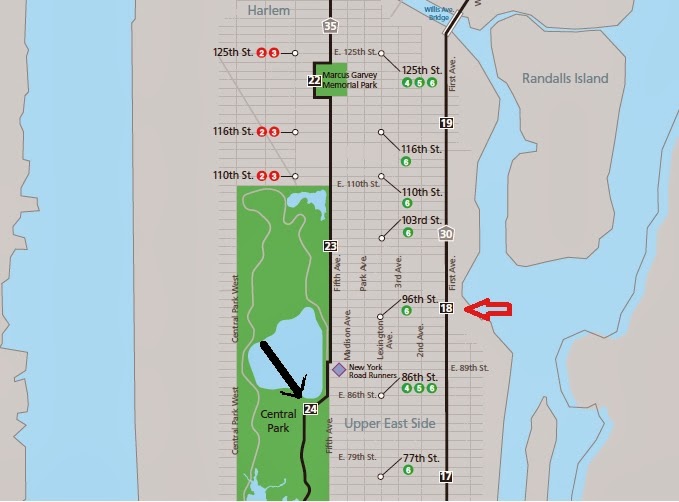
The above is a partial map of the course.  It shows that the course made a narrow loop in the Upper East Side.  Indeed, after passing the mile 18 checkpoint (see red arrow), Mr. X would only need to travel 6 blocks westward to rejoin the course on Fifth Avenue, pass through the mile 24 checkpoint (black arrow) and from then on reach the finish line.  No need for a car, carriage, bus or subway.  A leisurely walk sufficed.

Of course, results are so far unofficial, but why cheat?  Mr. X was not in contention for a medal, or money prize.  He was just one of over 50,000 men and women out there, testing their own mettle and enjoying a unique moment in the most vibrant city on earth.

I perused the results of 7 runners; of these, 2 appeared to be marred by some form of cheating.  That is a lot, although my sample is so small as to be statistically non-significant.  Still, given the severity of our macroeconomic and political problems, it got me thinking.  Will principles and attitudes change away from the marathon race?

After training hard for several months, my daughter finished her first marathon in 3 hours and 35 minutes.  We are very proud of her.

Thursday, September 26, 2013

Where have you been, Charlie Brown?


Charlie Brown turned 65 last year.  How time flies!  Last we saw him, he was still trying to kick that football, and Lucy was still up to her usual tricks.  Where has he been all these years?

Charlie: You would never guess, I went to college and stayed there; actually… I always knew I could make it, I just had to wait until my grades would improve as I knew they would… eventually.  I really wanted to get away from Lucy; actually, I worried too much about that, but it turned out alright.

Me: How so?

Charlie:  Lucy decided she was going to West Point, and there is no way they would have taken me there even if I had applied.

Me: How did she do?

Charlie: Well, she retired last year, as a two star general; she was the guest of honor at the Army-Navy game; that was nice of them, although I understand they had a hard time getting her off the field; they had given her the game ball and ...

Me: So what did you do after college?

Charlie:  Well I taught economics at Columbia for thirty years.  I wrote a few research papers with Linus (he was at Berkeley); he did the math part and I did the editing.  And then I went to the Fed in Washington.

Me: Really? So what do you make of it all, I mean, the taper?

Charlie: Gosh, I don’t know, I am in research, not policy-making.  In any case, and as you know, the chairman never promised to end the taper in September...

Me: But if the CEO of Goldman Sachs says on the morning of the FOMC decision that he expects a September taper, and thus gets it wrong, can the rest of us be expected to better read the Fed’s intentions?  Well maybe the Fed changed its mind at the last minute?

Charlie:  Can you ask me about Brazil, or Russia, or even Argentina?

Me:  OK, so where do we stand now?  I heard one FOMC member saying they might taper in October, and another saying that unemployment was too high and Washington pols too reckless to even think about it, and still another saying that the Fed’s perceived U turn had damaged the credibility of the institution… Charlie?  

Charlie:  Sorry, got to go, Patty and I got the grandkids for the weekend!

Sunday, July 14, 2013

Latin America: an investor’s point of view


Latin American stock markets have incurred heavy losses so far in 2013; what’s more, they have underperformed developed markets by a wide margin:

Countries
Gain/loss y-t-d A
Gain/loss y-t-d in US$ B
Argentina[1]
+12%
-1.6%
Brazil
-24.2%
-31.4%
Chile
-13%
-17.6%
Colombia
-14.3%
-20.7%
Peru
-27.6%
-33.5%
Mexico
-7.5%
-7.4%

By comparison, the American S&P500 is up 17.1%.  Even much maligned Western Europe is up, with the laggards (Italy and Spain) suffering losses which are half those of the regional leader, Mexico.  What do we make of it?

Short term, the diagnostic of most observers has some validity, mainly that with the drop in commodity prices, the economic growth of Latin American countries has been decelerating which in turn has weakened their currencies.  Having been the darlings of international investors, these commodity producers are now under the same shadow as China, heretofore the main driver of commodity prices.

Another valid observation is that emerging markets got carried away in the post 2008 recovery, which resulted in very fast increases in both corporate debt issuance and stock valuations; then a series of sobering international news and fear of Fed tightening widened corporate spreads and reduced EM p/e multiples.

As usual, it is easier to construct causality links by analyzing data bases than by weighing qualitative factors.  Yet I believe that the latter are more important for the medium and long-term.

For example, despite assertions to the contrary, it is clear that Latin American markets are viewed by many investors as an asset class, so that national stock markets within that region will tend to move together, irrespective of their merits and specific characteristics.  This is best illustrated by the case of Mexico: its terms of trade have changed little in many years, its economy is more closely linked to the US than to China, its financial markets are more liquid and more free.  Its stock market performed less bad than the others, but one could have expected it to tag along the S&P500 and be in the green. 

Peru is the other example of contagion.  Yes, it is the commodity play par excellence; mining profits have suffered and the economy as a whole did slow down.  But its finances remain the best in the region with a moderate current account deficit, a small budget surplus and ample foreign exchange reserves.  More importantly, good macroeconomic management has been the trademark of successive governments rather than a recent phenomenon.  It doesn’t seem logical that it underperformed Brazil.

I have been bearish on Brazil since President Lula announced the restructuring of Petrobras and the offshore oil sector.  More than any of its neighbor, Brazil’s misfortunes are self inflicted:

1.     Disjointed monetary policy where BNDES makes long term loans at interest rates below overnight interbank rates,

2.     Heavy handed government intervention in the oil and gas, electric utility and financial sectors to the detriment of minority shareholders,

3.     Unpredictable foreign exchange policy aimed at manipulating the parity of the currency,

4.      Overly complex and arbitrary tax and regulatory system,

5.     Disconcerting government which, on the one hand, professes to stand for (somewhat) free markets while nurturing foreign alliances with regimes that stand at the polar opposite.

I don’t see the economy improving substantially and private investment returning unless and until a more centrist government is voted in.  Good center-left models would include Ricardo Lagos and F. H. Cardoso.  Presidential elections are scheduled for next year and recent popular protests in Brazil may bring about change.  If not, the future will be bleak.

There is little to say about Argentina: its institutions are in shamble, its economy is atrophied and beset by highly distorting regulations.  Besides the poor performance of its stock market in US dollar terms, one number says it all: in 2012, total foreign direct investments into Argentina totaled $3billion[2] vs. $13billion for Chile, $15 billion for Colombia, $40 billion for Mexico and $50 billion for Brazil.

Chile has perhaps been the most surprising under-performer, as its stock market losses have been double those of Mexico.  Clearly, the large weight of its mining sector in the economy and its exports has accounted for a good deal of this disappointment, but not all.  As I have written in this blog, I think that reform fatigue has set in.  This is understandable when one realizes that a generation has passed since Chile embarked on its trailblazing economic and social reforms.  The fact that other left of center regimes in the region have spent public funds with abandon has made it that much harder for Chile to steer a virtuous path.

New presidential elections will be held next November.  Former President Bachelet is the current favorite; however her discourse is more radical than her first term policies.  As I wrote in this blog, her call for scrapping the Decree Law 600 which has guaranteed a stable foreign investment regime is emblematic of a shift in the making and of the social pressures she believes she is under. 

Even under the current administration of President Piñera, there were some unsettling signs in an otherwise market-friendly framework; these included efforts to weaken the currency and unrelated attempts by NGOs and local groups to stop large scale mining projects[3].  Chile still enjoys a stable legal system and rock-solid public finances, but it is clear to this writer that the future may be different for investors, especially the foreign ones.  In a small country so dependent on exports, this is not a good sign.

Colombia is perhaps the most interesting example.  In a little over a decade, its economy and financial markets have soared. To wit: in 12 years, the market value of Grupo de Inversiones Suramericana, the largest private business conglomerate in the country, rose by a factor of 33 in US dollar terms.  This revival has been largely due to the government success in fighting guerillas and drug traffickers and in reestablishing a safe environment.  Repressed for years, economic activity blossomed, aided in no insignificant manner by the existence of a large domestic market.

However, after overheating in certain sectors, the picture has darkened.  Again, there are many obvious measurable factors to explain it: slowing global economy, comparatively weak US dollar, investor angst, etc.  But some of the wounds are self inflicted:

1.     Economists can well consult their models to prove how beneficial a “’competitive” currency can be; but to the investor, it is one more factor of uncertainty and a drag on performance when the peso loses 8% in 6 months.  It also extracts a heavy price when a company such as Ecopetrol postpones its dollar borrowing exercises, only to discover that market conditions have changed for the worse;

2.     More importantly, both the perception and reality of security in the country have worsened.  Most people are unsure of where the negotiations with the FARC will end.  President Santos is widely regarded as very shrewd, but he may play his cards too close to the vest, and this is not conducive to risk-taking by businesses and investors.

In sum, there is no doubt that world economies and market confidence are more fragile than they were some years back.  One of the costliest consequences of the so-called Great Recession is that policy makers, having lost confidence in free markets, are now convinced that they can manipulate economies and markets back to health.  What they fail to realize is that businesses and investors are more comfortable handling normal free-market dynamics than arbitrary governmental policy inputs.

Another lesson is that investors pay close attention the most basic and essential aspects of economic and political governance, and more so when risk tolerance has fallen: government meddling,  onerous tax regimes, predictable rule-making, transparency, stable and effective legal systems DO matter.

The flood of liquidity orchestrated by the main central banks of the world since 2008 did affect Latin America as it brought about a surge of portfolio investing in fixed income instruments; yet Latin America is not totally without blame:

1.     One can think of the very high short term interest rates practiced by Brazil for example, and

2.     The region could have done better promoting productive investments in infrastructure.

In sum, there is no disputing that human emotions weigh in as much as rational analysis.  Mexico and to a lesser extent Peru seem to have been overly punished by fleeing EM investors.  But the same cannot be said of others; indeed, what concerns this writer about Brazil, Chile and Colombia is a policy drift away from what made them successful in the first place, and this has little to do with China buying less copper or iron ore.


[1]   The US dollar loss was calculating using the official exchange rate.  If one uses the exchange rate implicit in the pricing of such Argentine ADR as Telecom Argentina, then the dollar loss exceeds 49%.
[2]  What is more, this number probably overstates true FDIs as it is likely to include reinvestments by Argentines of monies held abroad.
[3]   Unfortunately, some companies such as Barrick Gold gave them good reasons to criticize environmental non-compliance.

Friday, June 28, 2013

For whom does the (Chilean) bell toll?


There are few more emblematic legal constructs in emerging market finance than the Chilean DL600.  What Michael Phelps is to swimming, the Decree Law 600 is to foreign direct investments: both defined an era and both set very high bars for their successors.

It is thus very significant that former president Michelle Bachelet, now the leading candidate to return to that office, proposed to eliminate the DL600.  Apparently, this would be part of a set of new policies, such as raising corporate income taxes, to generate more public revenues to finance greater social expenditures.

I have observed for a few years now that a sort of frugality fatigue is setting in Chile.  Chile was the first, and for decades, the only Latin American country to embrace an economic model based on budgetary equilibrium, personal financial responsibility and free enterprise.  The first signs lassitude started to appear after twenty years of effort.

One important area of friction has been the private pension system.  Another more recent has been education.  In my view, a major factor in the sentiment shift has been the change in regional politics.  Center-left moderates such as F. H. Cardoso in Brazil (1995-2003) and R. Lagos in Chile (2000-2006) and center-right A. Uribe in Colombia (2002-2010) have been replaced by N. and C. Kirchner in Argentina (2003- present), H. Chavez and N. Maduro in Venezuela (1999- present); these new populist regimes have actively promoted government interventionism, budgetary laxity and public sector expansion.  Even Brazil, under presidents Lula (2003-2011) and Rousseff  (2004-present), has returned to greater government activism in economic affairs.  Virtue is difficult enough to preserve, but all the more so when temptation is all around.

The DL600 was promulgated in 1974 by the military junta (probably another feature which doesn’t endear it to President Bachelet) and has been a landmark piece of legislation. Besides its symbolic importance which cannot be underestimated, its success stems from its unique features:

·        Foreign investments instrumented via DL600 are approved via a contract between the investor and the State.  The strength of a contract is that its terms cannot be amended except by mutual consent of the parties.  No such protection exist under general legislation;

·        The DL600 guarantees a fixed corporate income tax rate of 42%[1] for a period of 10 years, extendable for a total of 20 years; it also fixes the mining royalty tax for 10 years;

·        Other guarantees include non-discrimination vis-à-vis local companies, access to foreign exchange and freedom to remit dividends and capital (after one year), freezing of the accounting for such items as depreciation and accumulated losses.

In a country where mining is the single biggest economic activity (and thus where capital investments are both very large and long-term), the assurance that the conditions under which one invests will not change is very valuable.  The success of DL600 can be measured by three numbers: $51 billion of foreign direct investments in 10 years in a country with a GDP of $164 billion[2].

It is debatable whether Chile would get tangible financial benefits from abolishing DL600.  If anything, it would signal that a Bachelet-led government would want to preserve the right to change FDI taxation, a rather worrying sign.  It would also reduce some of the competitive edge that Chile has had compared to such rivals as Peru.  Finally, it would send a not so subtle signal that budgetary discipline would be under greater threat since the government would open the way to higher taxation.

Perhaps it takes a foreign perspective to fully appreciate the value of the DL600.  From mine, I found that while other countries often presented more favorable terms for FDI, Chile generally won thanks to the stability of its institutional framework.  DL600, if abrogated, will be missed.


[1]  This compares with an effective tax rate of 35% assuming (1) all net profits are paid out in the form of dividends and (2) the foreign investor chooses not to avail himself of the terms of the Decree Law 600.
[2]  It is important to remember that by far the biggest mining entity in Chile is state-owned CODELCO whose investments are thus considered local and outside the DL600.


Wednesday, June 12, 2013

Quick recommendation update


As summer is approaching, it is timely to revisit some previous recommendations.

I just sold my Telecom Argentina shares for a 79% profit.  I continue to like the company’s management and its business, but the political and macroeconomic environment in which it operates (Argentina) is getting increasingly difficult.  Maybe it is the darkness before dawn, but given the gain which was to be realized and the uncertainty ahead, booking a good profit seemed appropriate.

Standard and Chartered plc, the UK international bank, has essentially been flat since our post of last August.  I maintain my negative stance: the business model, in my view, continues to be riskier than generally assessed and I am not comfortable with the bank’s corporate governance.  I am not short, I am just on the sidelines.

Finally, Apple made some important announcements, although more evolutionary than revolutionary, at its annual developers conference.  We are still awaiting the unveiling of truly eye popping devices or services.  My previous price target of $600 pending the release of new products looks a bit too high; $500-$550 is probably more appropriate.  Nevertheless, I continue to hold the stock as it looks reasonably priced at current levels and increased dividends and share buybacks are positive.