Sunday, February 9, 2014

Zorro est arrivé


As related in prior posts, because of gross economic mismanagement, Venezuela is experiencing an acute shortage of foreign exchange.  The result is that local companies cannot pay for imports, which in turn causes them to cut back production and makes a bad situation even worse.  Recently, the franchisee for Toyota in Venezuela announced that it was closing for 45 days due to a lack of parts and components.  But a lack of dollars is not the only problem.
 
I thought it would be instructive to compare the initial response of President Nicolas Maduro to this crisis with that of Winston Churchill upon becoming Prime Minister.  You draw your own conclusions.

Nicolas Maduro[1]                   
I just ordered the Minister of Industry to summon the Head of Toyota for Latin America or somebody from Tokyo…Sometimes [companies] get desperate for no good reason…If one of those pencil-pushing managers[2] thinks he can alarm [the country], better watch out… It would seem that the only plan of these pencil-pushers is dollars, dollars and more dollars…Where is the capacity to create products in Venezuela if here we have everything: aluminum, petrochemicals, iron, steel.
 

Winston Churchill[3]
I would say to the House, as I said to those who have joined this Government: I have nothing to offer but blood, toil, tears and sweat…You ask, what is our policy?  I can say: it is to wage war, by sea, land and air, with all our might and with all the strength that God can give us…This is our policy.  You ask what is our aim?  I can answer in one word: victory, victory at all costs, victory in spite of all terror, victory, however long and hard the road may be, for without victory there is no survival.


[1]  As reported by the newspaper El Universal on 2/8/14.
[2]  In the Spanish original text: Un ‘gerentico’ de estos bureaucraticos.
[3]  Speech of May 13, 1940 at the House of Commons after Churchill had formed his government.

Wednesday, February 5, 2014

Latin America in 2014: part IV, in conclusion


The new year 2014 has seen a major retreat from emerging markets as investors sold both what they should and what they could.  Having started with political turmoil in Thailand and Turkey, the current train of worries has caught up with economic basket cases like Argentina and Venezuela and policy sinners like Brazil.

A rising tide lifts all boats, and during the last decade and a half, there were not one but two powerful tides: ample global financial liquidity and booming demand for commodities.  Under such conditions, even lead-bottomed boats happily bounced in the waves.  But commodity demand slowed abruptly with the advent of the Great Recession, and liquidity is no longer gushing except perhaps in Japan. 

In retrospect, where did investors who bet on the lead-bottom boats go wrong? In particular, where did political risk analysis err?

One big mistake was failing to recognize the true goals of some incoming government leaders.  Hugo Chavez, like Lenin and Mao Tse-tung before him, was driven by a strong ideology and was bent on thoroughly and irreversibly transforming society.  To these men, issues such as falling GDP, foreign trade and international investment flows were of little concern.  That is why the first would decapitate PDVSA and expropriate local and foreign companies, the second repudiate Russia's foreign debts and the third would carry out the Cultural Revolution.

These leaders were willing to incur international isolation, and even welcomed it, as a necessary condition to reach their primary objective.  In the case of Venezuela, it is interesting to note that a handful of very prominent local businessmen recognized this and took appropriate defensive measures early on, while most major industrial and portfolio foreign investors didn’t. 

To better understand incoming leaders' goals, it is very useful to read their writings, particularly those written in their youth[1][1].  Often, these writings are dismissed as erreurs de jeunesse[1][2], but when one considers the examples of Hugo Chavez and others, these men have been remarkably true to their youthful aspirations.  Budding emerging market investors, when a new charismatic and/or transformational leader is elected, DO look up his writings, whether these are one year or two decades old!

Culture and history also play a strong role in appraising political risk.  For example, communist China and the Soviet Union were able to create new structures that provided stability if not efficiency.  These structures were often based on similar ones that existed under prior regimes.  Venezuela, by contrast, has been unable to do the same.

Another useful warning sign of future trouble is financial and economic policies that work at cross purposes or governments that believe they can micro-manage their way to prosperity.  When policies start looking like a Cubist portrait, beware!  Examples include manipulating foreign exchange rates, inventing subsidies of all kinds, introducing price controls, and of course decreeing expropriations.  The problem with these is that they scare away private capital, without providing any substitute as government bureaucracies have neither the financial nor the human resources to step into the void which they created.

Where do we go next?  The truth is that, most developed and emerging countries will wait until the very end before making reforms.  Their governments will also weigh their chances for survival, remembering Alexis de Tocqueville’s observation that “the most dangerous time for a bad government is when it starts to reform”.  Eventual success will be depend on abilities, ideologies, culture and closeness to the abyss.

Brazil
Its vastness, its large population and its culture of moderation make it resistant to extremism.  While the Lula government represented a turn to the left and adopted populist rhetoric, particularly in foreign policy, it didn't yield to revolutionary temptations thanks to its trade union roots: unions fight to improve the standards of living of their members, they don't trash the productive apparatus.  That historical link weakened somewhat under his successor, Dilma Rousseff.

With the drop in commodity prices and investors’ new risk aversion, the government must take corrective measures to control public spending, reduce public debt and stimulate growth.  Recent popular demonstrations again lavish World Cup expenditures will further drive that message home.  Finally, the government activism in the economy, particularly in Petrobras and the electric sector, has proven disastrous:  Petrobras, once again, has become a bloated outfit with massive debts, a stagnant production and a crashing stock price[1][3].  The electric utility sector, which is very reliant on hydroelectric power plants[1][4], is operating near full capacity and subject to more frequent and massive blackouts.

There already is a change of attitude (with President Rousseff first trip to the Davos WEF); some policy changes are forthcoming ahead of next October general elections, bigger ones will come afterwards whether Ms. Rousseff and the PT win or lose.  It is clear that the popular support which President Lula and the PT enjoyed has since waned, that reforms are both needed and demanded.  I believe that they will materialize.

Venezuela
This is by far the biggest problem in the region.  The charismatic Chavez has been replaced by a man of little charisma, authority and apparent talent.  Much has been written about the government’s disastrous economic and monetary policies, the growing criminality and the accelerating breakdown of public institutions and large economic units.  Cuba, which plays a major role with its extensive intelligence and security presence, is keeping a low profile for now.

The deterioration of the economy has accelerated so far in 2014, the acute shortage of dollars is evident and the government has responded with what are essentially threats rather than clear policies.  China, already a major creditor[1][5], seems to have said “no mas”.  In the very short term, one can expect the government to further squeeze the local private sector and to enter into selective default, paying its foreign sovereign debt and little else.

Current policies will lead to an economic collapse.  Can this be avoided?  The opposition seems discouraged and in any case is ineffective; after all, it has understood that it can’t defeat Chavismo through elections.  The most interesting commentary on Venezuelan politics has recently come from 94 year old Luis Miquelina.  A former communist, supporter of Fidel Castro, he was an early supporter of Chavez serving as his justice and interior minister; he also served as a senator and president of the Constituent Assembly of 1999.

In a recent interview, Miquelina said the following:

-         -Venezuela is now an appendix of Cuba, which is unacceptable,

-         -The current communist government has destroyed the productive apparatus and private property rights, and it has displayed corruption without limit,

-         -There is no exit via elections as these have proven to be fraudulent; the fight must be brought to the streets,

-         -The army is as much a victim as the civilians and both must join forces,

-         -There can’t be negotiations with the government unless it is on the basis of rough equality of power.

Interestingly, the response to this blunt piece has been dead silence from all sides.

Although the situation could turn volatile quickly, a popular revolt looks unlikely right now.  Nevertheless, the current regime could try to preempt this eventuality by vesting governing powers into more capable hands.  But who has the credibility and power to reorganize inefficient public institutions and companies, to renegotiate the onerous oil deal with Cuba, and to convince the population to accept painful reforms?  I think that Chavismo will give it a try, perhaps attempting to co-opt some in the opposition, but in the end there will have to be a collapse before there can be a revival. 

So when you look at the region, as I did through our last four posts, you will probably share my conviction that Latin America will make headlines throughout 2014.  You may also share my guarded optimism that the balance will tilt, by a small margin, towards the positive.


[1]  These are not always easily available.

[2]  Litterally, errors of the youth.

[3]  Some 78% fall since the recapitalization of the company and the new deep-offshore regulations were announced in 2009.

[4]  Brazil is also suffering from a dry spell which is affecting the water reservoirs.

[5]  For about US$20 billion repayable in oil.


Tuesday, January 28, 2014

Latin America in 2014: part III, fin de fiesta


Argentina

Cinephiles of a certain age may remember the 1960 film, Fin de Fiesta[1] by the Argentinean producer and director Leopoldo Torre Nilsson. I certainly do, for its powerful script and black and white cinematography.

Ostensibly set in the 1930s, the movie recounted the excesses of a provincial caudillo, his brutal and corrupt exercise of power and his downfall.  The fact that the film’s opening was marred by public disturbances showed that, for many, this was not a movie about an age long gone.

And why not, for it held a mirror to Argentine politics where the reprehensible practices of the pre-WWII governments were replicated by others of different stripes in the following decades, where corporatism flourished, tinged later by populism, and where moderates always failed to marginalize right-wing and left-wing radicals; Frondizi (1958-1962), Alfonsin (1983-1989) and Menem (1989-1999) come to mind in this regard.

Almost seven decades after its eponym was elected president, Peronism is again in power, alive if not all that well, in Argentina.  And as happened in the past, another fin de fiesta is in the offing.

Despite enormous natural riches, over the last decade Argentina has managed to put itself in an economic hole by following a populist ideology which has resulted in huge distortions of and burdens on its economy and finances.  It has alienated almost anyone with money to invest or consume: foreign creditors were rudely handled in a 2005 restructuring which looked more like spoliation; retirees saw their private pensions taken over by the government and used to plug budgetary holes and finance YPF; frozen energy tariffs threatened the financial health of a whole sector of the economy; Repsol, the controlling shareholder of YPF was initially expropriated without any compensation; statistical data bases, essential for the management of private business and finance were either tampered with, such as the inflation rate[2], or simply not kept up to date.

The results have been telling:  while it exported 20 million m³/day of natural gas to its neighbors in 2004 (one year into Nestor Kirchner’s presidency), in July 2013[3] Argentina imported 16.9 million m³/day from Bolivia and the equivalent of 27 million m³/day in LNG[4].  The picture is similar for oil: Argentina turned from being a net exporter of US$5.2 billion in 2004 to a net importer of US$3 billion in 2013[5]; these numbers understate the turn for the worse because 2004 oil prices were less than half of those in 2013.

As for electricity, by freezing utility rates in 2002, the government triggered high demand growth [6] while setting strong deterrents for investments in new generation[7].  It is also facing a mounting bill for rate subsidies which currently exceeds 3% of GDP for electricity and natural gas alone.  In short, the reality is: pressure on public finances and recurring blackouts in summer.

The erratic management of the economy and its finances has led to general underinvestment, the effects of which go well beyond the energy sector: a potentially high value-adding sector such as industry has been forced into retreat; the local automobile industry is now barely more than an assembly line where valuable components are imported from abroad.  The overall result is a rising need to increase imports when the country can least afford it, hence the never ending import tariffs, taxes and other restrictions to try and keep the trade balance in the black.

It is clear that the external situation of Argentina is unsustainable.  Official foreign exchange reserves stand at US$29 billion.  The IMF estimates that the country will suffer a cumulative current account deficit of US$29.1 billion over the next four years.  It cannot access international markets to raise debt financing.  Assuming that foreign direct investments were to remain flat at US$3 billion a year[8], this would leave Argentina with reserves of US$12 billion by year-end 2018, equivalent to a little over 2 months of imports.  Needless to say, a financial meltdown would occur well before that point.

It is therefore hardly surprising that the government decided to depreciate the peso by some 18% last week.  It is also hardly surprising that the government blamed speculators for its miseries.  While this move may provide some temporary respite, it will not be enough: the roots of the difficulties, excessive public spending, haven’t been dealt with, the government has little credibility and seems to improvise as it goes along[9].

In the end, these latest announcements show that the populist peronist economic model is reaching its limits.  The current government will likely be forced to make further policy adjustments to try and attract foreign money[10] and reduce public accounts imbalances; after coming to terms with Repsol in order to permit YPF to develop shale oil resources, Argentina is likely going to have to do the same with holders of its unrestructured foreign debt.  It will then need to make peace with exporters. 

Real reforms will need a government that enjoys more credibility and trust both at home and abroad.  That is for 2015/2016 perhaps, but the pendulum has started to swing back.  More and more, the priority of this government will be to reach 2015 without causing a massive economic and social breakdown.


[1]  Literally, the end of the party.
[2]  IMF issued a rare warning to Argentina for its poor handling of official statistics.
[3]  Up from 9.7 million m³/day a year earlier.  Bolivian gas imports are limited by pipeline capacity.  They are planned to increase to over 19 million m³/day shortly.  Current exports have plummeted to a few hundred thousands of cubic meters
[4]  Ource: Platts.
[5]  IMF projections.
[6]  CAMMESA, the wholesale market administrator, estimated in 2008 that, on average, electricity tariffs in Argentina were 1/3 of the Latin American average.
[7]  The government has made some tariff adjustments since then.
[8]  A puny number when compared to Colombia (US$15 billion, Mexico US$40 billion and Brazil US$50 billion).
[9]  A 20% surtax on the newly but limited purchases of dollars, was subsequently waived if these dollars were deposited at a bank for at least one year.  The much hyped possibility for individuals to buy dollars for savings purposes failed to convince as these dollars would have to remain in a bank account and Argentines remember what happened to their dollar accounts in 2001-2002 with the “corralito”.
[10]  Including dollars held abroad by Argentines.

Friday, January 24, 2014

Latin America in 2014: part II


Chile

For almost forty years, Chile has had the best performing regional economy, one based on a free market model designed by the Chicago Boys[1] and on the development of globally competitive export industries (orchestrated by the FundaciĂłn Chile, ironically an offshoot of ITT, the “Great Satan” of the 1970s).

Remarkably, this strategy which had been elaborated by a military regime, has been pursued with only minor alterations by a succession of center-left governments and most recently by center-right President Piñera.  For the first time however, there are some doubts as to whether this continuity will be maitained.

President-elect Bachelet has campaigned on a platform of broad fiscal and social reforms to be funded by higher tax revenues.  Interestingly, her political discourse is significantly to the left of her actual policies when she was in office in 2006-2010.  Some of her other proposals include creating a public pension program and the elimination of the bedrock of foreign direct investment, the Decree Law 600.

Why would President Bachelet change tack?  Is she doing what she wanted to do back in 2006, but politically couldn’t do?  More likely, she is responding to popular pressure and weak global economics, combined with regional populism and reform fatigue at home.

Perhaps the most emblematic proposal is the elimination of the DL 600[2]: in a country where half of the foreign investments are very long term (mining), the DL600 has provided the critical assurances of regulatory and financial stability.  The results have been impressive: US$51 billion in foreign direct investments over the last 10 years in a country with a GDP of $164 billion.  And DL600 was no gift to foreign investors either, as they had to accept paying income tax at a higher rate to avail themselves of the benefits of the DL600.

The proposed termination of the DL600 is all the more surprising since Chile is more reliant on exports (mostly from mining) than its regional peers[3]: these account for 34% of GDP vs. 17% for Argentina and 11% in Brazil.  Despite a sustained diversification effort, copper and other minerals still represent the lion's share of exports.  It is one thing to tell foreign investors that their income will be taxed at a higher rate; it is quite another to imply that the terms under which they made a large investment can now be changed at any time and affect such issues as non-discrimination vis-Ă -vis local competitors, accounting and profit remittance rules, access to foreign exchange, etc.

In truth, Chile has long had active leftwing political parties and movements, and with populism on the rise in the region, they too have upped the ante.  This has been apparent with demonstrations for free education for all, with blocking electric power projects which had received the approval of government environmental authorities, with blocking mining projects in coordination with local communities, NGOs and some governmental units (in truth, some of these projects were not in full compliance) and recently with a union strike shutting down the main ports of the country and stopping copper and fruit exports[4].

As the speed of regional events seems to be overtaking this blog, it may well be that, once again, Chile will be out of phase with its big neighbors, Argentina and Brazil: successful when these were floundering and declining when these start to shape up.  For even if market forces extract a price for her policies, President Bachelet will be forced to deliver on some of her electoral promises.
 
In conclusion, it is likely that President Bachelet will be forced to water down some of her new policies, simply because they are unaffordable and because the opposition is nor without recourse.  At the same time, Chile is like an ageing Olympic swimmer who, after 15 years of twice-a-day hard practices, finds it increasingly harder to go on, particularly when his friends and neighbors stay in bed until 9 a.m. and play video games.  Foreign investors will take notice, and so will local ones.


[1]  The term refers to a group of young Chilean economists who studied at the University of Chicago and later returned home to formulate and execute free market policies.  Among them were Sergio de Castro (minister of finance 1977-1982), Jose Piñera (minister of labor 1978-1980 and author of the groundbreaking private pension reform), Sergio de la Cuadra (minister of finance 1982-1983), Miguel Kast (minister of planning 1978-1980), and Hernan BĂĽchi, (minister of finance 1985-1989).
[2]  For greater details on the DL 600, please refer to my post of June 28, 2013.
[3]  Countries with GDP per capita of at least US$10,000.  2012 data.
[4]  Current value of affected exports is estimated at US$ 1 billion.  By their nature, fruits are expected to suffer the more serious losses.

Monday, January 13, 2014

Latin America in 2014: part I


Muchos años despuĂ©s, frente al pelotĂłn de fusilamiento, el coronel Aureliano Buendia habĂ­a de recordar aquella tarde remota en que su padre lo llevo a conocer el hielo.  Macondo era entonces una aldea de 20 casas de barro y cañabrava construidas a la orilla de un rio de aguas diáfanas que se precipitaban por un lecho de piedras pulidas, blancas y enormes como huevos prehistĂłricos.  El mundo era tan reciente, que muchas cosas carecĂ­an de nombre, y para mencionarlas habĂ­a que señalarlas con el dedo[1].
 Gabriel GarcĂ­a Marquez, One Hundred Years of Solitude

Few novels have had as powerful and magical beginnings, and when GGM’s book, once translated, reached Europe and the US in the late 1960s, it instantly put Colombia on the literary map.  Subsequent GarcĂ­a Marquez novels were anxiously expected and read, and by and large, didn’t disappoint although never quite matching their trailblazer.  Soon, the world rediscovered older Latin writers such as Neruda and Borges, and welcomed the likes of Vargas Llosa, Cortazar, Fuentes and others. 

Since then, through periodic ups and downs, Latin America has more often than not faded from the headlines.  I believe that in 2014 it will make a return.  Paraphrasing GarcĂ­a Marquez again, time is not passing, it is turning in a circle. 

There have been many attempts to draw parallels, to put Latin countries in neat boxes, in short, to simplify the Latin reality.  Like all generalizations, these efforts contained some elements of truth that had little overall predictive value.  Indeed, while there have been two principal colonizing influences, Spanish and Portuguese, there also have been important[2] immigration flows from Italy, Germany, France and the Middle East.  At present, there appears to be a political and economic cleavage between Atlantic (Venezuela, Brazil, Argentina) and Pacific (Chile, Peru, Colombia, Mexico) countries but this distinction wouldn’t have existed thirty years ago.  Finally, there is a tendency to bundle Latin American countries together as commodity producers; many do export commodities but their customers are somewhat different and so is the mix between hard and soft commodities.  In the end, because of topography, demography and history, one should consider each country separately.  Evidently, being in the same neighborhood, there has been and always will be interaction among them.

2014 should bring to the fore a number of important challenges and issues which will probably result in heightened volatility and tensions in this region, and ultimately, major changes.  Let us consider these Latin countries on a case by case basis.

Colombia
No single factor explains the resurgence of the Colombian economy better than the drastic improvement in the security climate in the country, and in particular the beating back of the FARC and drug traffickers since 2003.  Pipeline attacks is a good index of security levels as it affects the most dynamic sector of the economy. 

This chart from Valores Bancolombia shows that attacks reached their lowest point at the end of President Uribe’s second term in office. Unfortunately, they are now back up to their level of a decade ago.

President Santos has staked his legacy on reaching a peace accord with the FARC.  By all accounts, he is thoughtful and deliberate, and he is correct in emphasizing the huge benefits that peace would bring.  The question is how do we get there?  Was the relaxation of the pressure on the insurgents necessary?  Will waning support from Venezuela pressure the FARC to settle?  Will FARC leaders, lately seen relaxing on the beach in Cuba, lose their fighting ardor and want to retire?  Will the Colombian population accept terms that would allow reinsertion of the FARC in society and politics?  More crucially, will a successful political negotiation with the FARC bring an end to the involvement of its members in drug trafficking and violence?

On a macroeconomic level, the Colombian economy is both healthy and dynamic; it enjoys a large domestic market and relative proximity to North America.  A key challenge is developing an efficient infrastructure which is all the more necessary by an unforgiving topography; after some significant delays, it appears that the legal and regulatory framework for large scale project development is now ready.

Right now, President Santos looks likely to win reelection next May; this would be good to convince the FARC if they want to make a deal.  But the November 2013 deadline for a deal has already passed, and it is unlikely that the negotiations can be extended much longer unless the security climate is improved.  2014 should therefore force the parties to make some tough decisions:  the President either breaks the negotiations or he applies greater military pressure on the FARC to force a settlement; the FARC either settle soon or face the risk of harsh military retributions with no domestic or international support.

My guess is that, as elections approach and time for negotiations runs out, violence rises but the security climate improves, and we have already seen what this means for the economy.


[1]  Many years later, as he faced the firing squad, Colonel Aureliano Buendia was to remember that distant afternoon when his father took him to discover ice.  At that time Macondo was a village of 20 adobe houses, built on the bank of a river of clear water that ran along a bed of polishes stones, which were white and enormous, like prehistoric eggs.  The world was so recent that many things lacked names, and in order to indicate them in was necessary to point.  (Unfortunately, this translation fails to convey the poetry and rhythm of the original text)

[2]  Not in absolute numbers but in terms of their importance for the host countries.

Monday, November 4, 2013

Coubertin’s principle


The marathon race is the most awe inspiring event in sports. The first man who reportedly ran the whole 26 miles from Marathon to Athens, a messenger in ancient Greece, collapsed and died after announcing victory over the Persian army.

Modern races have been less deadly but no less grueling.  Torn between a desire for glory and their own physical or mental limitations, some runners have not hesitated to cut corners, literally.

The initial winner of the 1904 Olympic marathon was subsequently disqualified when it became known that he had ridden 11 miles in a car.  The original bronze medalist at the 1896 Olympics rode part of the way in a carriage.  More recently, some runners have taken advantage of the advent of newer modes of transportation: the female winner of the 1980 Boston Marathon was disqualified for having taken the metro, others took a bus.

Nowadays, runners are equipped with race timing devices which record when they reach successive stages in a race.  From this measurement, split times and speeds are calculated and published; in the case of the New York Marathon, times are recorded every mile after mile 8.  Yet human nature having changed little, individuals remain fascinated with this mythical race and will bend principle to be recognized as successful participants.

Yesterday, we were in Manhattan to watch one of our daughters race the 2013 NY Marathon.  Afterwards, we went online to check how some friends and acquaintances had fared.  My wife by accident typed a wrong name.  To better understand, I am adding the race date on another runner whom I will call Mr. Comp. 

This is what we got:

 
The above graph shows the progress of two runners.  The left vertical axis displays their pace per mile while the bottom horizontal axis displays the length of the race.  The pace is calculated for the overall distance covered. 

The black line of Mr. Comp has a typical profile: after averaging 9 minute/mile for the first 5 kilometers, the runner slowed gradually down; by mile 14, his average pace had dropped to 10.5 minute/mile and he then maintained a 12¼ minute/mile over the last 3 miles.  Throughout the race, Mr. Comp’s electronic tag registered his splits, as evidenced by the dots in the black line.

Mr. X is a different story altogether: through mile 18, his profile is also typical as he gradually slowed down.  From mile 18 to 24, his tag didn’t record any time split.  Yet he was so fast during that portion of the race that he raised his cumulative pace to its highest level of the day.  Indeed, his "recovery" was astounding: from the mile 17 to the mile 18 marker, his pace was about 14 minute/mile; since his tag recorded his times at miles 18 and 24, it is easy to calculate that he covered that 6 mile segment at a pace of a little over 5 minute/mile!  Probably exhausted by this massive acceleration, Mr. X covered mile 24 to 25 in 12 minutes and mile 25 to 26 in 15 minutes. 

What happened?

 
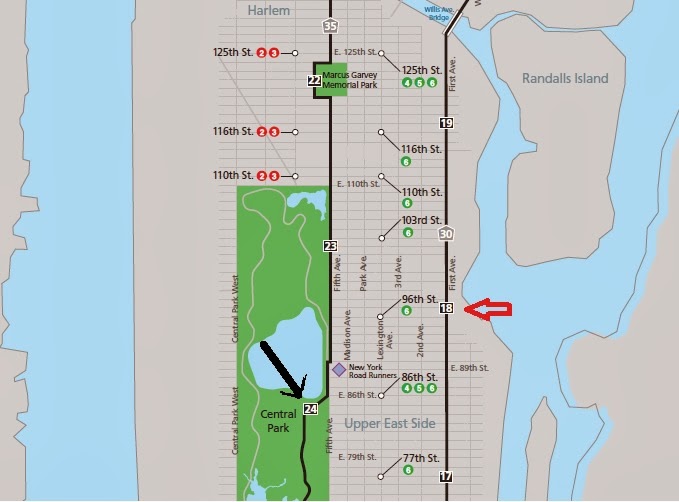
The above is a partial map of the course.  It shows that the course made a narrow loop in the Upper East Side.  Indeed, after passing the mile 18 checkpoint (see red arrow), Mr. X would only need to travel 6 blocks westward to rejoin the course on Fifth Avenue, pass through the mile 24 checkpoint (black arrow) and from then on reach the finish line.  No need for a car, carriage, bus or subway.  A leisurely walk sufficed.

Of course, results are so far unofficial, but why cheat?  Mr. X was not in contention for a medal, or money prize.  He was just one of over 50,000 men and women out there, testing their own mettle and enjoying a unique moment in the most vibrant city on earth.

I perused the results of 7 runners; of these, 2 appeared to be marred by some form of cheating.  That is a lot, although my sample is so small as to be statistically non-significant.  Still, given the severity of our macroeconomic and political problems, it got me thinking.  Will principles and attitudes change away from the marathon race?

After training hard for several months, my daughter finished her first marathon in 3 hours and 35 minutes.  We are very proud of her.